
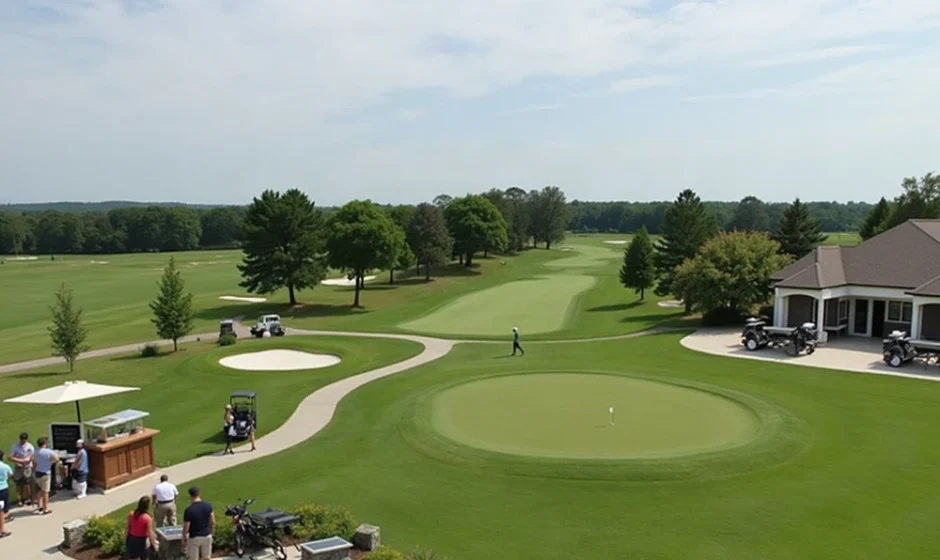

Image Recommendation: A shotgun-start tournament in progress across multiple tees on the Sime Course, with a food station and digital leaderboard screen visible near the clubhouse.
A private round for three flights and a corporate tournament for thirty flights are organised on the same golf course, but they are not organised the same way. What works perfectly for a handful of colleagues playing a relaxed weekend round starts to break down once the guest list grows past a certain point, start times, dining format, even how scoring gets tracked all change shape.
Where the Planning Genuinely Starts to Differ
1. Start format: a small group can simply tee off in sequence, while a large tournament typically needs either a staggered timesheet or a shotgun start, where every flight begins simultaneously from a different hole.
2. Dining logistics: a handful of golfers can be accommodated easily in Tee Top Restaurant’s regular service, while a large group usually needs a pre-arranged format, running lunch, food stations, or a dedicated buffet.
3. Coordination: a small private round needs minimal advance planning, while a large corporate event benefits from a course inspection and a dedicated sales contact well ahead of the date.
Why a Shotgun Start Matters Once Numbers Climb
A corporate golf event with enough flights to fill the course benefits from a shotgun start specifically because it compresses the whole round into a single, predictable window, every group finishes at roughly the same time, which matters considerably for anything planned around the round, an awards presentation, a closing dinner, or transport arrangements for guests leaving afterward.
What Changes on the Dining Side as Numbers Grow
A table for four can be seated at short notice. Catering for several dozen golfers finishing a round at roughly the same time needs a format chosen in advance, a running lunch keeps people moving without a bottleneck, on-course food stations let golfers eat between holes without pausing the whole field, while a sit-down buffet suits a group gathering together afterward for a more formal close to the day. None of these formats work well as a last-minute decision once the numbers are large.
How Team-Building Elements Scale Differently Too
A friendly Nearest-to-the-Pin or Longest Drive challenge works easily within a small private round, added almost casually. At tournament scale, the same challenges need their own coordination, someone tracking results at specific holes, a way to announce and verify them, and a moment built into the schedule to recognise winners, usually tied to the dining or closing segment of the day.
Questions Worth Settling Early for a Larger Event
Does the group size genuinely need a shotgun start, or would a staggered timesheet work just as well?
That threshold varies, but once a group approaches double-digit flights, a shotgun start generally keeps the day moving more predictably than a staggered sequence.
What dining format fits the group’s schedule and budget?
This is worth deciding before the event date is confirmed, since catering formats at scale need more lead time than a standard restaurant booking.
Who’s coordinating the day-of logistics, registration, goodie bags, scoring, on the organiser’s side versus the venue’s?
Clarifying this upfront avoids both sides assuming the other is handling a particular detail.
Why Private Golf and Corporate Events Share More Groundwork Than It First Appears
Even a modest private golf booking for a small group benefits from some of the same thinking that scales up for a larger event, confirming course availability, deciding on a dining format in advance, and settling who’s bringing what. The difference at scale is mainly how much lead time and coordination each of those same decisions actually needs.
Why a Course Inspection Earns Its Place in the Planning
For anything beyond a small private round, walking the course ahead of the actual event date tends to resolve questions that are far harder to answer from a description alone, where food stations would realistically sit without disrupting play, how a shotgun start would actually stagger across the holes available that day, and whether the group size under consideration genuinely fits comfortably or would feel rushed. That inspection is a small amount of upfront time that tends to prevent a much larger scramble closer to the event date.
The course itself doesn’t change between a quiet weekend round and a thirty-flight tournament. What changes is how much coordination sits underneath the day, and planning for that earlier rather than later is usually what separates a smooth large event from a stressful one.
Working out the right format and lead time for a specific group size is easier with a direct conversation than a general guide. Contact Keppel Club to start planning.